
Lamar County Parole Versus Probation
Parole is a conditional release from a Texas Department of Criminal Justice sentence before final discharge. The Texas Board of Pardons and Paroles makes the release decision, while the TDCJ Parole Division supervises the person. Mandatory supervision is another state release category created by statute. It can be discretionary under current law. Neither term means that a court erased the conviction or that the sentence has ended.
Probation is commonly called community supervision in Texas. A judge orders it, often instead of incarceration or after a short local custody term. A Lamar County court judgment identifies the term and the community supervision and corrections department responsible for it. Someone may start probation without ever entering TDCJ. A person may also leave Lamar County Jail with no supervision at all.
| Point | Parole or mandatory supervision | Probation |
|---|---|---|
| Authority | BPP decision and Texas release law | Lamar County court order |
| Supervisor | TDCJ Parole Division | Community supervision and corrections department |
| Starting record | TDCJ offender detail and IVSS | Judgment and court docket |
| Custody link | Follows a TDCJ prison term | May begin without a prison term |
| Ending event | Discharge or other official termination | Court-recognized completion or termination |
- Parole
- Conditional release from a state prison sentence under TDCJ supervision.
- Mandatory supervision
- A statutory state release to supervision, subject to eligibility rules and sometimes board review.
- Community supervision
- The Texas term commonly used for court-ordered probation.
- Discharge
- The official end of the relevant sentence or supervision term.
Check Lamar County Parole Records
Start with the TDCJ offender search when parole or mandatory supervision is possible. A TDCJ number or state identification number gives the best match. Name searches can produce several people, so compare offense, county, status, and other identifiers before relying on the result. The state record may show a projected release date, parole eligibility date, current facility, and status-related information. It is not the Lamar County jail database.
Next, use TDCJ IVSS for a person in TDCJ custody or on parole or mandatory supervision. This system supports status checks and confidential notifications. It is separate from IVSS-Counties, which handles county custody events. For questions after a favorable parole vote, TDCJ Parole Division Review and Release Processing can be reached at 512-406-5202. Approval does not by itself prove that physical release has occurred.
- Collect the full name and TDCJ or SID number, if known.
- Search TDCJ and compare the county, offense, identifiers, and status.
- Check TDCJ IVSS for the matched state offender and current event options.
- Use the Parole Division directory to identify the assigned office.
- Confirm a release or discharge through TDCJ when the displayed status is unclear.
For broader context on a release record, the Lamar County released-inmate search explains how county, state, and court records fit together. A county jail departure may instead be a transfer to TDCJ, another county, a federal custodian, or immigration custody.
Verify Lamar County Probation Status
Begin with the Lamar County judgment and docket. District-court felony records route through the District Clerk. Matters within county-level jurisdiction route through the County Clerk and the County Court at Law. Look for the phrase “community supervision,” its term, conditions stated in the public record, and the department named to administer it.
A jail release timestamp proves when local physical custody ended. It does not establish probation by itself. Pair the timestamp with the signed judgment or later order. A bond release can occur while the case continues, and a dismissal of one charge does not resolve another hold. When a docket entry is hard to read, request the underlying order rather than inferring its meaning from a short code.
- Identify the court and case number tied to the release.
- Request the judgment, sentence, and later supervision orders.
- Confirm whether the order imposes community supervision.
- Use the current Lamar County directory to contact the named department.
- Ask the supervising office to confirm assignment before visiting.
Certified court copies can establish the terms shown in the file. The supervising department remains the source for current assignment details that are lawfully available.
Route Lamar County Supervision Correctly
A Lamar County conviction does not guarantee an office assignment in Lamar County. State parole placement may follow the approved home address, a transfer, an interstate compact, or a specialized caseload. Geography alone is not enough. Use the TDCJ Parole Division directory, then confirm the district office before making contact.
Texas Parole Records Route
Texas Department of Criminal Justice Parole Division
Office assignment: confirm through the official district directory
Release processing after a favorable vote: 512-406-5202
Find the assigned parole office
Court-ordered probation starts with the local judgment instead. The responsible community supervision department should be verified through Lamar County's current official directory and the court record. BPP does not supervise probation, and a probation order does not prove a state-prison release.
TDCJ's release-type page distinguishes parole, mandatory supervision, discretionary mandatory supervision, and medically recommended intensive supervision. Those labels matter because each one describes a specific state path, not a general term for anyone who left jail.
Note: Confirm the assigned office before traveling because residence, transfer, and specialized caseload rules can change the supervision location.
Lamar County Parole Review Process
Ordinary Texas parole consideration is a file review. The Board of Pardons and Paroles review process begins when the Parole Division identifies an offender for review. An institutional parole officer prepares a case summary. A three-member panel then votes in sequence, and two matching votes decide the case. The person receives the decision by correspondence.
A favorable decision can carry conditions and further processing. A denial includes a later review date where the law permits one. Eligibility only permits review; it does not promise approval or release. Government Code section 508.145 contains different rules based on the offense, sentence, findings, and offense date. A projected date and a parole eligibility date therefore answer different questions.
The official review sequence can be seen on the BPP parole review page.
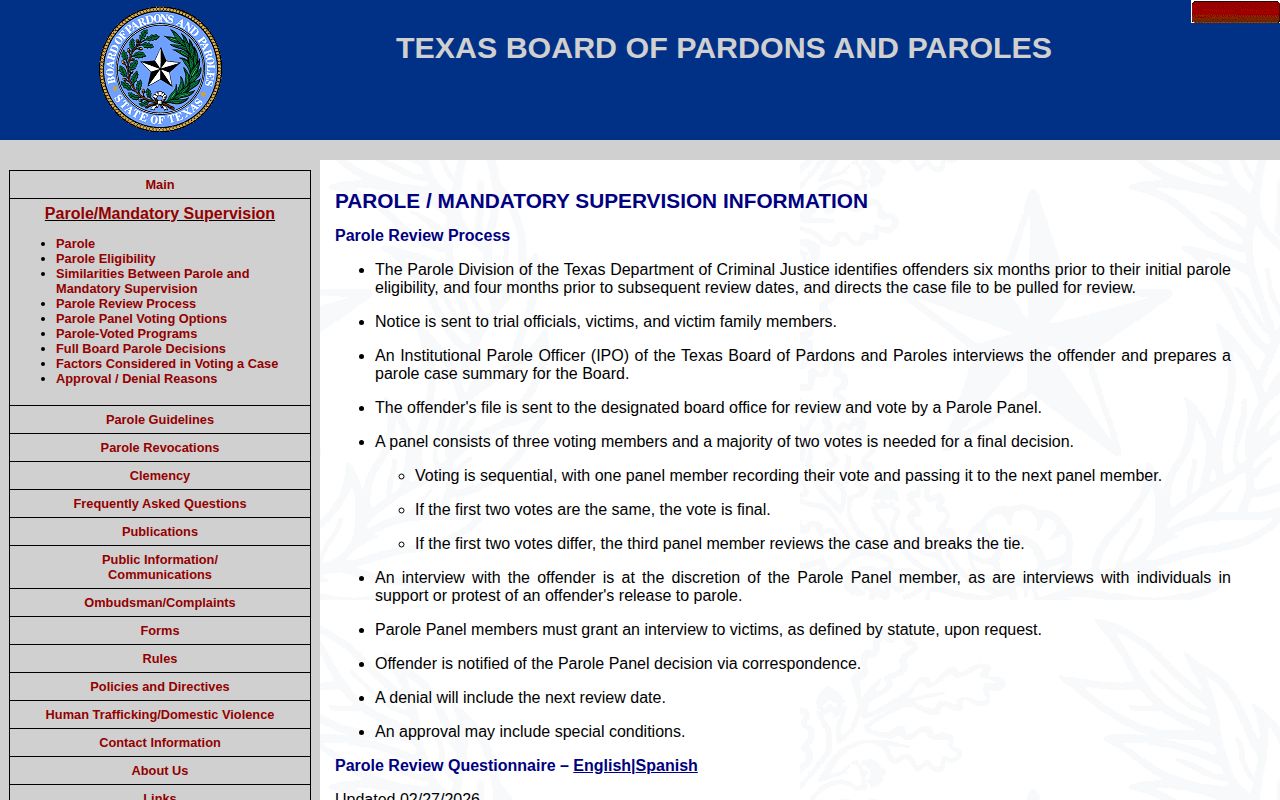
The captured state page supports the file-review route and should not be read as a Lamar County public hearing calendar.
Lamar County Parole Release Types
Parole and mandatory supervision are not interchangeable. Parole is a discretionary conditional release approved by BPP. Mandatory supervision arises from a separate statutory framework, and for many later offenses its release decision is discretionary. Medically recommended intensive supervision has its own eligibility and review path. The exact label in the official record should control.
Texas also distinguishes release to supervision from final discharge. A person on parole remains under the state sentence. Conditions may address reporting, residence, travel, programs, or other case-specific duties. Public summaries should not be used to guess private conditions. The supervising officer and official documents provide the reliable answer.
The official TDCJ release-types material shows the state categories.
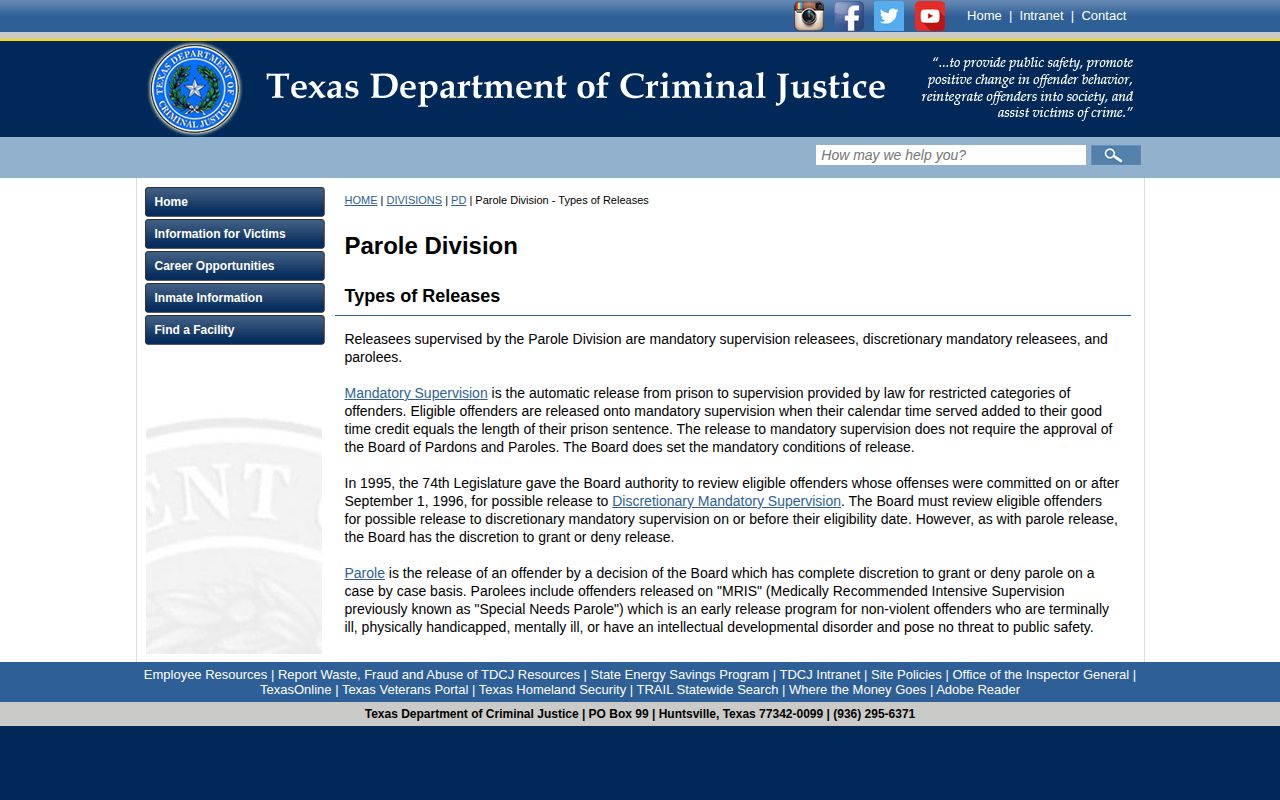
This source helps separate state release categories from Lamar County probation and county-jail discharge.
Lamar County Warrants and Violations
An absconder claim means the supervision agency alleges that a person stopped complying or reporting. It is not a new conviction. A blue warrant or revocation warrant can seek custody based on an alleged parole violation. Probation violations follow the court process tied to the community-supervision case. Public details may be limited, and similar names make informal claims risky.
Check the issuing system. For state parole, compare TDCJ and BPP status, TDCJ IVSS, and any lawfully public warrant information. For probation, inspect the Lamar County docket for a motion or order to revoke and confirm the status with the court or department. If the sheriff holds the person, the jail controls the current local custody event.
Revocation is not the same as initial parole review. Revocation proceedings can involve administrative hearing rights and outcomes such as continued supervision, changed conditions, an intermediate sanction, or revocation. The allegation alone does not establish the result.
End Lamar County Supervision Records
Supervision ends through an official event, not merely the passage of an estimated date. A TDCJ discharge can mark the end of the state sentence. Parole may end at discharge after all legal requirements are met. A Lamar County probation term ends according to the court's orders and the administering department's records. Another warrant or case can still affect custody.
Keep the final discharge notice, court order, or other official completion record. If an online status has not caught up, ask the originating agency for the existing record and note the date of the search. An IVSS alert is useful notice, but it is not a certified discharge record.
Release also does not mean that every court or jail record disappears. Texas expunction and nondisclosure are distinct court remedies with eligibility rules. A missing search result may reflect a data delay, a name mismatch, or a legal access limit. It should not be treated as proof of discharge.