
Lamar County Release Record Basics
A Lamar County release is the end of one custody event, not proof that every case or restraint has ended. The Lamar County Jail can release a person after a bond is accepted, a court directs release, a county sentence is complete, or another lawful basis is processed. It can also transfer the person to the Texas Department of Criminal Justice, another county, the U.S. Marshals Service, or immigration custody. A person who leaves the jail roster may therefore be free in the community or still held elsewhere.
The most reliable proof is a chain of official records. The jail record shows the physical endpoint. A court order or judgment explains the legal authority. If custody continued, the receiving agency supplies the next status. This distinction matters because a bond release leaves the case pending, probation can begin without a state-prison stay, and parole is conditional release from TDCJ. A discharge ends the stated custody term, but a separate hold can still apply.
A missing roster entry is only a clue. Lamar County has not published a fixed period during which a released booking stays visible online. Nor does the official sheriff page offer a historical release archive. For that reason, absence from a live view should lead to a jail inquiry and a request for the release or transfer entry.
- Discharge
- The end of the stated term of custody or supervision.
- Time served
- A court disposition crediting confinement already completed.
- Detainer
- A request or authority that may keep a person held for another agency.
- Parole
- Conditional release from TDCJ before full sentence discharge.
- Probation
- Court-ordered community supervision, often without a prison release.
Lamar County Inmate Release Types
The label on a Lamar County jail event determines which record should be checked next. Similar words can prove very different facts. “Bonded out” confirms release pending the case, not an acquittal. “Dismissed” can resolve one charge while another hold remains. “Transferred” means the person left Brown Avenue but stayed in government custody.
| Release event | Meaning | Next record |
|---|---|---|
| Bond or personal bond | Community release while the case continues | Bond order, docket, and jail timestamp |
| Time served or sentence complete | County confinement credited or completed | Judgment and jail release entry |
| Dismissal or court order | A court supplied release authority | Signed order plus custody log |
| Probation | Court-ordered community supervision | Judgment and local supervision office |
| TDCJ transfer | State custody continues | TDCJ offender search after intake |
| Federal, ICE, or other-county transfer | Another custodian takes control | Receiving system and court file |
Staff must process the release authority and check holds before a community release. No official Lamar County source reviewed states a fixed hour for releases or promises weekend timing. The dated jail entry, rather than an estimate, establishes when that work ended.
Lamar County Release Record Fields
A release record is not always a stand-alone certificate. Relevant fields can sit in a booking sheet, custody-event log, bond record, court file, or transfer entry. A narrow request should identify the person and booking range, then name the existing items sought.
| Field | What it shows |
|---|---|
| Booked name and identifiers | Which person the custody event concerns |
| Booking number and time | The local jail episode and its start |
| Arresting agency and charges | The agencies and allegations tied to booking |
| Bond type and amount | Whether pretrial release terms were set |
| Actual release date and time | When Lamar County physical custody ended |
| Disposition or reason | Bond, time served, court order, transfer, or other event |
| Releasing authority | The court or legal authority behind the event |
| Receiving agency | Where custody continued after a transfer |
A booking photograph is a separate item and should be named in the request if needed. The court judgment may show sentence credit and disposition without the minute of release. The jail log may show that minute without the full case history. Pairing both gives a stronger and clearer record.
Request Lamar County Release Records
The Texas Public Information Act is the main documentary route when no online archive exists. Send a written request to the Lamar County Sheriff’s Office and ask for existing records, not an explanation or a custom report. Give enough detail to locate the booking and ask for electronic delivery if preferred.
- Identify the person by full booked name, birth date if needed, and approximate booking or release range.
- Request the booking sheet and jail custody or release-log entry.
- Name the desired fields: actual release or transfer time, disposition, releasing authority, and receiving agency if public.
- Request the related release authorization and booking photograph separately when relevant.
- Ask the sheriff to identify the legal basis for withheld parts and release segregable public information.
- Keep the request, estimate, response, and files together as the provenance trail.
125 Brown Avenue
Paris, TX 75460
903-737-2400
Fax: 903-783-0668
Confirm records hours and current electronic submission instructions.
Texas Attorney General request guidance explains that the Act covers existing information. Government Code 552.221 calls for prompt production, meaning as soon as reasonably possible under the circumstances. It does not promise production within a universal ten-business-day period. Charges can apply under state rules, so ask for an itemized estimate when required.
The official public-record request page is shown below. Its guidance helps frame a request around records the jail already maintains.

The screen reinforces why a precise custody-event request works better than asking staff to research why a release occurred.
Lamar County Release Record Law
Texas Government Code chapter 552 establishes access to public information held by government bodies, subject to statutory exceptions. It applies to recorded information. It does not require Lamar County to create a new certificate, calculate a date, or answer legal questions. Active-investigation details, confidential identifiers, juvenile material, medical information, security data, and records restricted by other law may be withheld or redacted.
Online display and legal retention are different. Texas local retention schedules apply by record series, while court files follow their own rules. A short or absent web view does not prove that the source record was destroyed. If a public entry is gone, ask the proper custodian for the retained booking, custody, or court record.
Expunction under Code of Criminal Procedure chapter 55A and nondisclosure under Government Code chapter 411 are distinct court remedies. Nondisclosure limits specified public disclosure; it is not universal erasure. An expunction order has different legal force. Search absence may therefore reflect a lawful restriction, not a data failure.
Lamar County Release Court Proof
Lamar County release verification splits between two court-record routes. Felony judgments and orders in district court begin with the Lamar County District Clerk. Applicable misdemeanor matters begin with the County Clerk and County Court at Law. The case number and court identify the right custodian more reliably than the arresting agency alone.
Compare the signed or filed court date, the jail’s actual release timestamp, and any supervision start date. They can differ without conflict. A bond order can authorize release before processing ends. A judgment marked time served can explain the legal basis but not the precise exit time. The jail log proves the physical endpoint, while the correct clerk’s file explains why it was authorized. This Lamar County two-custodian split is essential when a short jail label does not tell the full story.
Find Lamar County Released Inmates
Start with the last known custodian and a well-matched identity. Gather the full legal name, aliases, birth date, approximate booking date, and any booking, case, SID, or TDCJ number. Name-only results can collide. Then follow the branch that fits the person’s actual custody history.
- For a local jail episode, check the sheriff page and Texas IVSS-Counties, then call the jail.
- Ask whether the person was released to the community or transferred, plus the effective date and time.
- Request the written jail entry and match it to the correct Lamar County court record.
- For a TDCJ transfer, search state identifiers after intake and distinguish projected from actual release.
- For conditional release, verify parole or mandatory supervision through TDCJ; verify probation from the judgment and local department.
- For federal or immigration custody, use the matching federal system and court record.
The Lamar County Jail release page gives the local facility path. For a named person, the jail’s dated custody record remains more probative than a cached listing or alert timestamp.
Lamar County Release Search Channels
The official Lamar County Sheriff page supplies the jail contact and points to Texas IVSS, but it does not publish a historical release archive or defined recent-release feed. That absence makes the telephone and written record routes central. Texas IVSS-Counties works best for a named person and a notifiable custody change, not for compiling everyone released during a day.
The sheriff page captured in the manifest shows the county’s official contact-oriented access point.
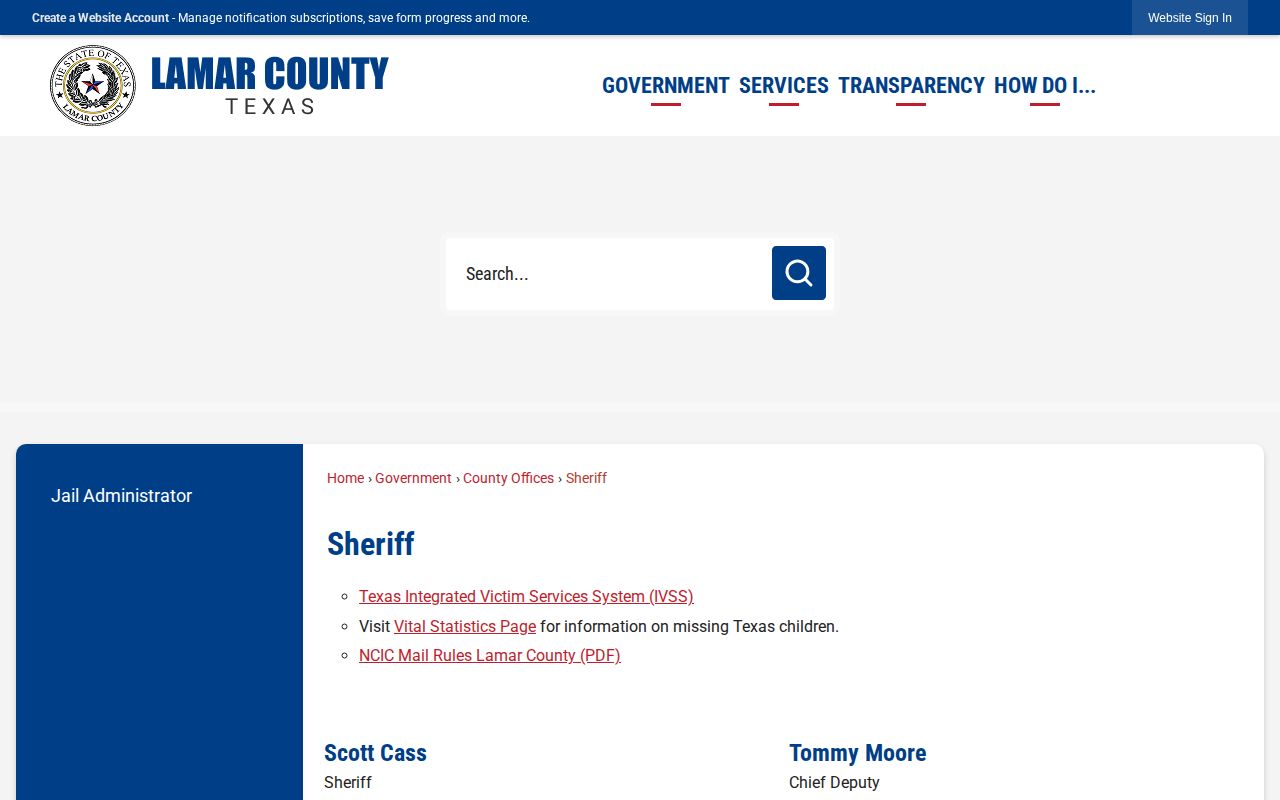
Its visible resources support direct confirmation and notification routing rather than an assumed roster archive.
For a complete day or three-day cohort, request an existing daily release report, release log, or jail-management-system report for exact start and end times. Ask for booked name, booking number, booking and release timestamps, disposition, and receiving agency if public. If no single report exists, ask for the closest maintained custody-event record rather than demanding a new spreadsheet.
TDCJ Lamar County Release Search
The TDCJ offender search is for state corrections records, not ordinary Brown Avenue bookings. It accepts a last and first name, TDCJ number, state identification number, gender, and race. Unique numbers are the strongest keys. A matching detail may show current facility or status, projected release date, parole eligibility date, offenses, and county information.
| Search field | Use | Limit |
|---|---|---|
| Last and first name | Broad identity search | Names can collide |
| TDCJ number | Direct state-record match | Applies only after TDCJ assignment |
| SID | Texas identifier match | Must be entered accurately |
| Gender and race | Narrow a name search | Do not replace unique identifiers |
The official TDCJ search form is shown here with its state-specific fields.
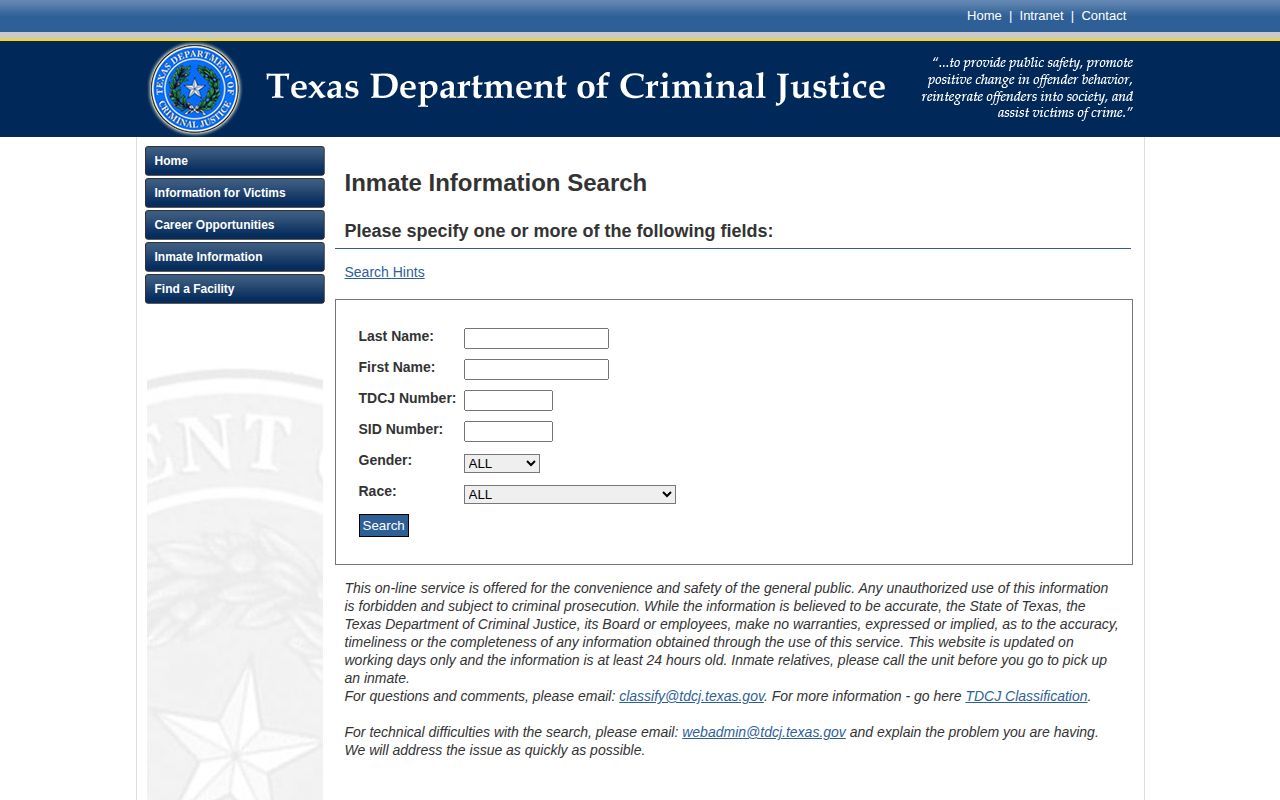
The form should be used only when TDCJ was a custodian. A local detainee who never entered state prison may not appear.
“Projected Release Date” is not proof of release. TDCJ calculates a scheduled date only after required decisions, certificates, and audits, and it can still change. After the event, confirm updated status or request TDCJ information. The agency also accepts a free email inquiry at pia@tdcj.texas.gov with the full name and seven-digit TDCJ number, or suitable birth and conviction details if the number is unknown.
Lamar County Release Alerts
Texas replaced the old county VINE service with Texas IVSS-Counties. The county portal handles local custody events. A separate TDCJ IVSS portal handles state-prison custody and parole or mandatory-supervision events. Choosing by custodian prevents a common false negative.
The county IVSS portal shown below provides the correct starting point for a Lamar County jail subject.
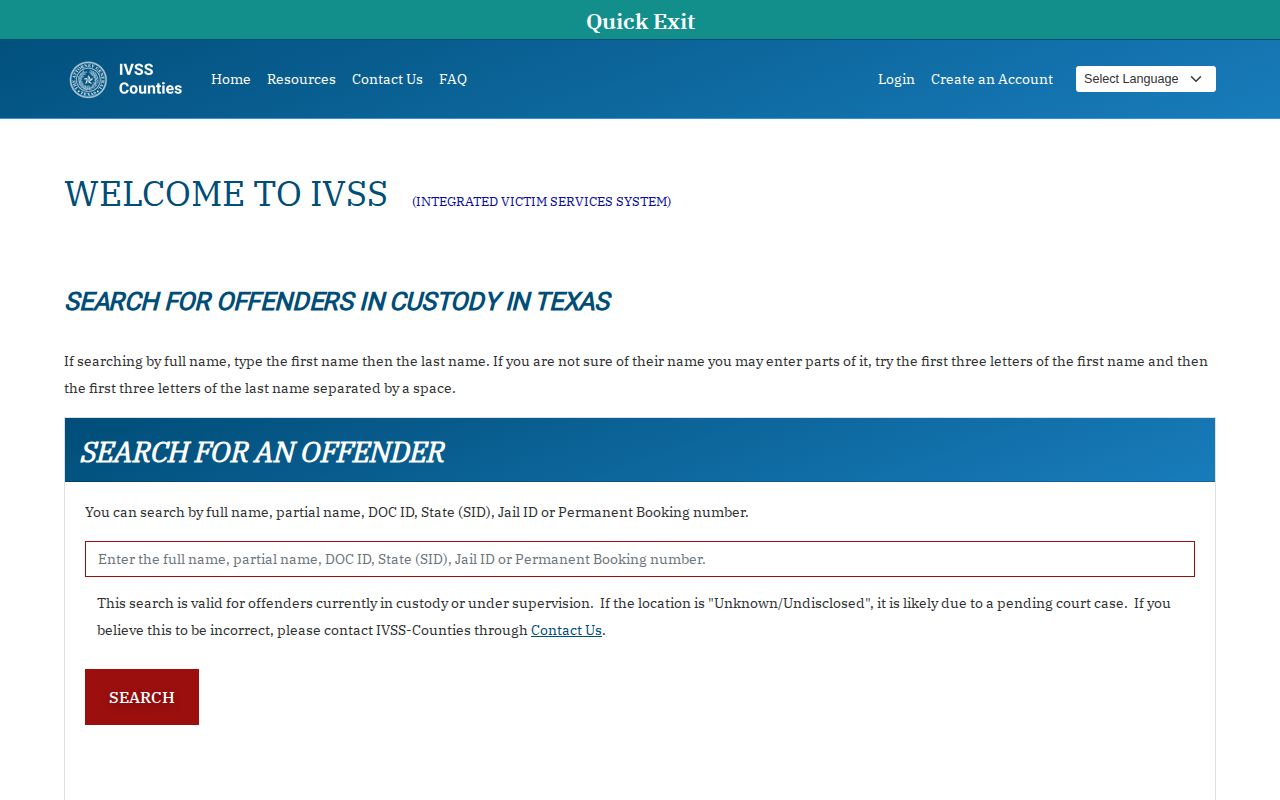
A displayed release event should still be reconciled with the Brown Avenue jail entry because notifications depend on agency data transmission.
Search the exact identity, compare the agency and identifiers, then open the matched record. If notification is needed, use the registration choices shown by the current portal and keep contact preferences current. A transfer alert calls for a receiving-agency search. No result may reflect spelling, identifier, feed, or timing issues and does not prove freedom.
Lamar County Release System Boundaries
Federal and immigration records sit outside the county and TDCJ systems. The BOP Inmate Locator covers federal inmates from 1982 onward and may display “Released” with a date. USMS handles many federal pretrial and transfer cases, so a federal docket or prisoner inquiry may be needed before BOP receives the person.
The BOP locator captured for Lamar County research illustrates the federal-only search route.
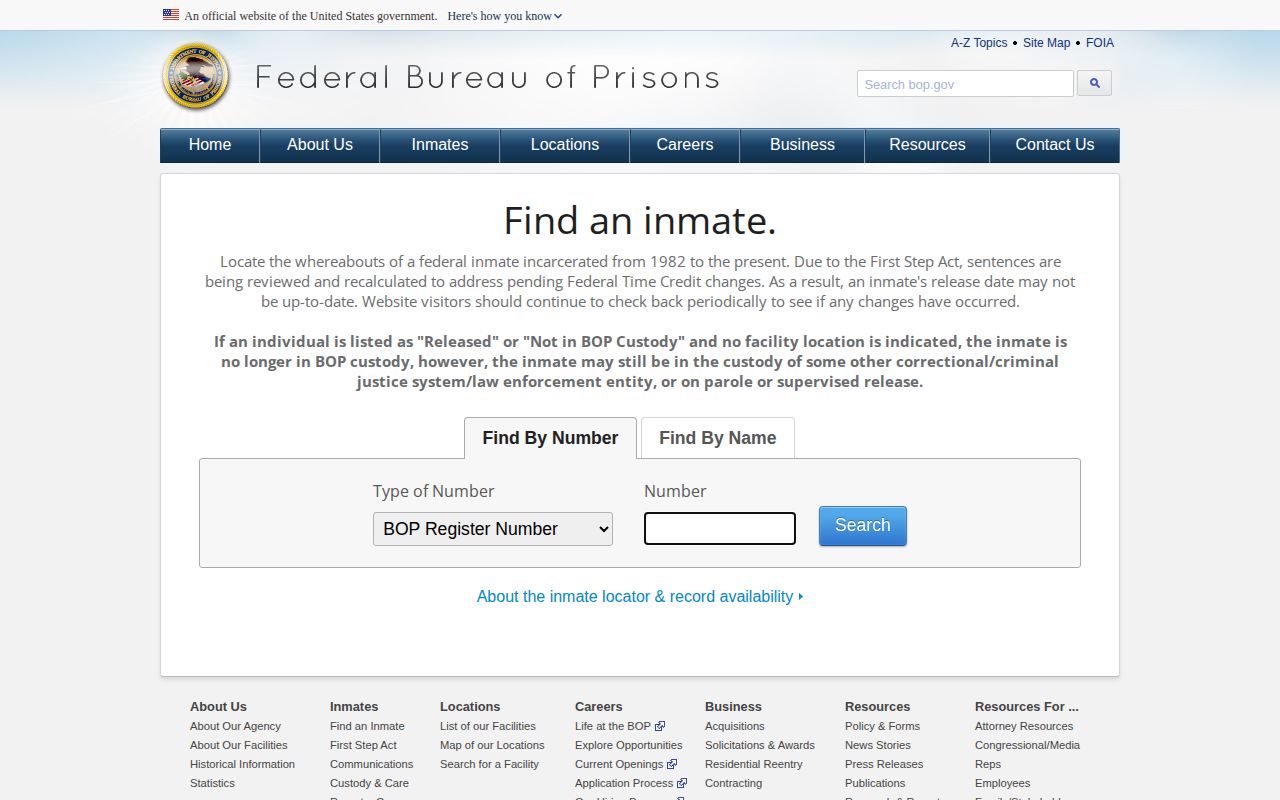
A BOP result does not prove an ordinary Lamar County jail release, even when a federal agency was involved in the case.
The ICE detainee locator searches current, searchable immigration custody. A missing result can mean transfer, release, removal, input mismatch, lag, or a non-displayed category. If Lamar County says a person was released to ICE, treat that as a transfer until ICE supplies the later outcome. The Texas DPS registry is also narrow: it can confirm a current registration duty but is not a general release list.
Lamar County Release Status Comparison
Each official channel proves a limited fact. Matching the question to the source prevents a current-custody tool from being mistaken for a release archive.
| System | Best use | What it cannot prove alone |
|---|---|---|
| Lamar County Jail | Local booking, actual release, or transfer event | Later state or federal outcome |
| Lamar County court file | Legal authority, judgment, bond, or dismissal | Exact time jail processing ended |
| IVSS-Counties | Named local status event and alerts | Certified historical release record |
| TDCJ search and IVSS | State custody, dates, parole, or discharge context | County-only jail episode |
| BOP locator | Covered federal custody and released status | County or immigration release |
| ICE ODLS | Searchable current ICE detention | Why a result is absent |
Question: Does a court dismissal prove the person left jail? Not by itself. It can explain one case’s result, but the jail release entry confirms the physical endpoint and can expose another hold or transfer.
Lamar County Release Facility
The Facility Map identifies one verified local detention site: Lamar County Jail, operated by the Sheriff’s Office at Brown Avenue in Paris. It holds local pretrial detainees, qualifying county-sentence inmates, and people awaiting lawful transfer. A felony sentence can move a person to TDCJ, while federal, immigration, warrant, or other-county authority can send the person to another system.
No TDCJ prison unit, BOP institution, or dedicated ICE detention center was identified within Lamar County in the official directories reviewed. That geographic fact does not keep a Lamar County resident out of those systems. State, federal, and immigration custody must be searched in their statewide or national databases.
For the local endpoint, call 903-737-2400 with full identifiers and ask one direct question: was the person released to the community or transferred? Follow with a request for the date, time, disposition, and destination shown in the maintained record.