
Match Lamar County Custody First
The same name can appear in local, state, and federal records, but each system calculates dates under different authority. Lamar County Jail handles local pretrial detention and qualifying county sentences. TDCJ handles state prison sentences after transfer and intake. BOP handles sentenced federal prisoners. A county booking number cannot be treated as a TDCJ identifier, and a federal release date does not explain a county jail event.
Review the judgment when custody type is unclear. A felony commitment may send a person from Brown Avenue to TDCJ, making the later date a state calculation. A bond, dismissal, time-served order, or county sentence remains tied to the sheriff's custody entry and local court file. This first routing choice prevents a plausible date from the wrong system from being reported as the answer.
Transfers matter too. Leaving the Lamar County roster for TDCJ, another county, USMS, or ICE continues custody under a new agency. Ask whether the person was released to the community or transferred before comparing any dates.
Lamar County Projected Versus Actual Release
Texas uses several date labels that answer different questions. A projected release date is a calculation under the laws and facts that apply to a TDCJ sentence. A scheduled release date appears after approval, prerequisites, and a records audit. Actual release is the event that ended custody or moved the person to supervision. None of these labels should be silently substituted for another.
A person awaiting trial at Lamar County Jail may have a bond amount or a coming court date, but that is not a fixed release date. Bond must be posted or another release authority must act, and staff must check other holds. A county sentence has its own credit and good-time framework. TDCJ calculations apply only after the person enters state custody.
- Projected release date
- TDCJ's calculated date under applicable sentence and release law.
- Scheduled release date
- A later date calculated after approval and required records work.
- Actual release
- The physical custody endpoint shown by the responsible agency.
- Parole eligibility date
- The first possible review point under law, not a promise of release.
Find Lamar County Inmate Release Dates
Start with the last known custodian. Call Lamar County Jail at 903-737-2400 for a person still at Brown Avenue or serving a county sentence. Ask whether the person is pretrial or sentenced, whether a release date has been calculated, and whether another hold or transfer affects the result. For a written answer, request the existing jail-credit worksheet, release calculation, and custody entry rather than asking staff to create a new forecast.
For a state prisoner, use the TDCJ offender search. Search by TDCJ number or SID when possible. Name, gender, and race can narrow a match. Open the detail and record the exact labels for status, current facility, projected release date, parole eligibility date, offense, and county.
- Identify whether Lamar County Jail, TDCJ, BOP, or another agency has custody.
- Collect the full name, birth date, booking number, TDCJ number, SID, and case number available.
- Use the custodian's official search or direct records contact.
- Compare the displayed date with the judgment, offense date, credits, and holds.
- Ask whether the date is projected, scheduled, or completed.
- Verify the event again after the stated date.
If TDCJ's online record is incomplete, its inmate-information email route accepts the full name and seven-digit TDCJ number. If that number is unknown, provide an exact birth date or approximate age and county of conviction. TDCJ lists incarceration history and projected release information among the data available through that free service.
Read TDCJ Projected Release Dates
TDCJ's public label is “Projected Release Date.” Its meaning depends on the offense date and release eligibility. For certain eligible offenses committed before September 1, 1996, the projected date can reflect the mandatory-supervision framework then in force. For later eligible offenses, mandatory supervision can require a discretionary BPP decision. For a person not approved or not eligible, TDCJ says the projected date will be the discharge date.
That definition is why a visible projected date is not a guaranteed day of freedom. Parole review, mandatory-supervision review, program needs, records checks, and the sentence itself may still matter. The state's Classification and Records function audits the file after a release certificate arrives and then calculates a scheduled release date and location. TDCJ warns that the scheduled date can change, even on that date.
The official TDCJ inmate-information page shows the projected-date definition and email fields.
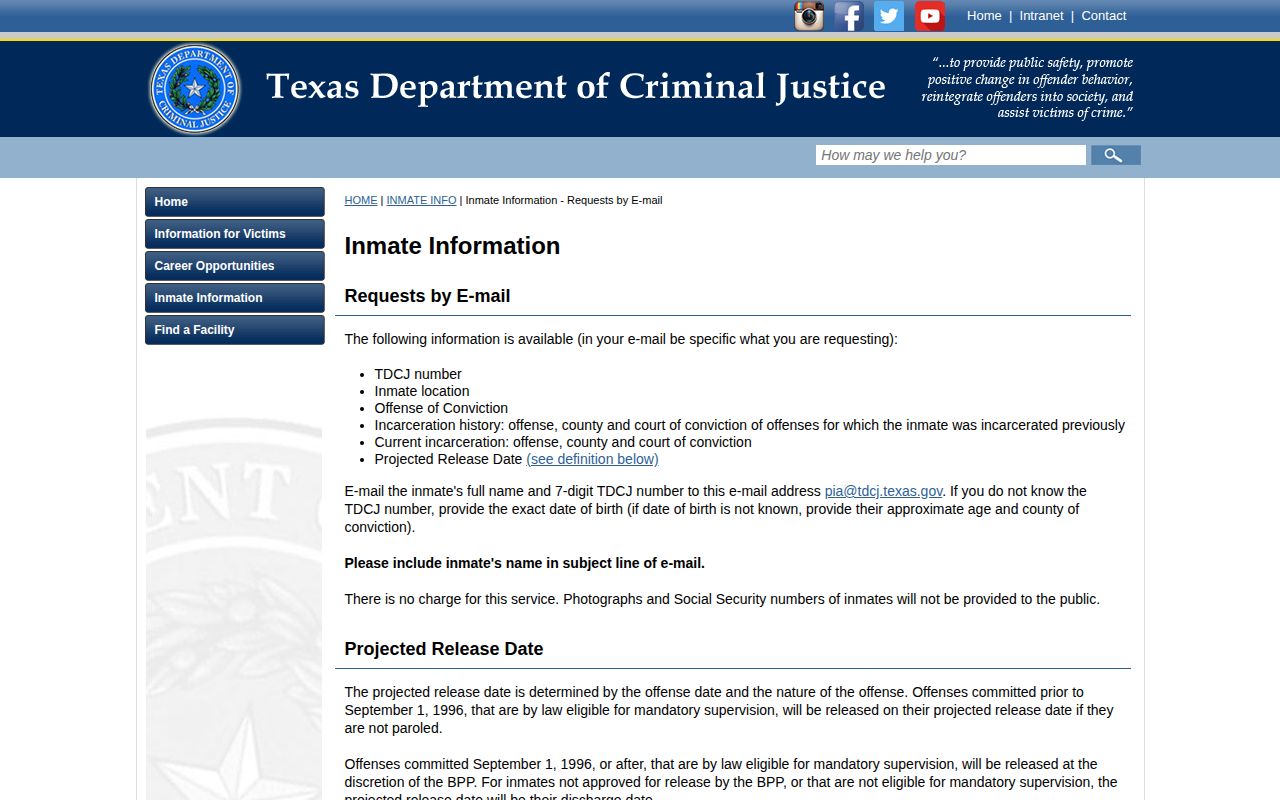
The state screen documents TDCJ data only. It cannot calculate a Lamar County Jail release for someone who never entered state custody.
Lamar County Good-Time Calculation
Texas Code of Criminal Procedure article 42.032 gives a county sheriff authority to grant commutation for good conduct, industry, and obedience. The statute generally allows up to one day for each day served, subject to its terms. The word “may” is crucial. The maximum is not an automatic Lamar County award.
Lamar County's written jail calculation policy was not found in the reviewed official sources. A person-specific answer therefore requires a request to the sheriff for the current policy and the individual's jail-credit or release worksheet. Do not copy the TDCJ projected date formula into a county-jail calculation. County commutation and state good-conduct time arise under different laws and are administered by different custodians.
Ask for the sentence start, court-awarded jail credit, credit applied, forfeiture or restoration entries if maintained, concurrent or consecutive treatment, and any hold that affects release. The sheriff need only provide existing records and may redact protected material. The request should not demand a custom legal opinion.
This Lamar County distinction is set out in Code of Criminal Procedure article 42.032. It is the local calculation rule, not proof that a given inmate earned the statutory maximum.
Texas Good Time and Eligibility
TDCJ good-conduct time is governed principally by Government Code chapter 498. Credits may be awarded, forfeited, or restored as the law and agency rules allow. They can affect classification and release eligibility. They do not rewrite the sentence imposed by the court, and they do not guarantee parole.
Texas does not use one universal “serve 85 percent” rule for all state prisoners. Government Code section 508.145 contains different formulas by offense, finding, sentence, repeat-offender status, and offense date. For specified serious offenses, subsection (d) generally requires actual calendar time equal to one-half of the sentence or 30 years, whichever is less, and excludes good-conduct time from that eligibility calculation. Other cases follow other subsections.
The official good-time statute is visible in the Texas Legislature's chapter 498 text.
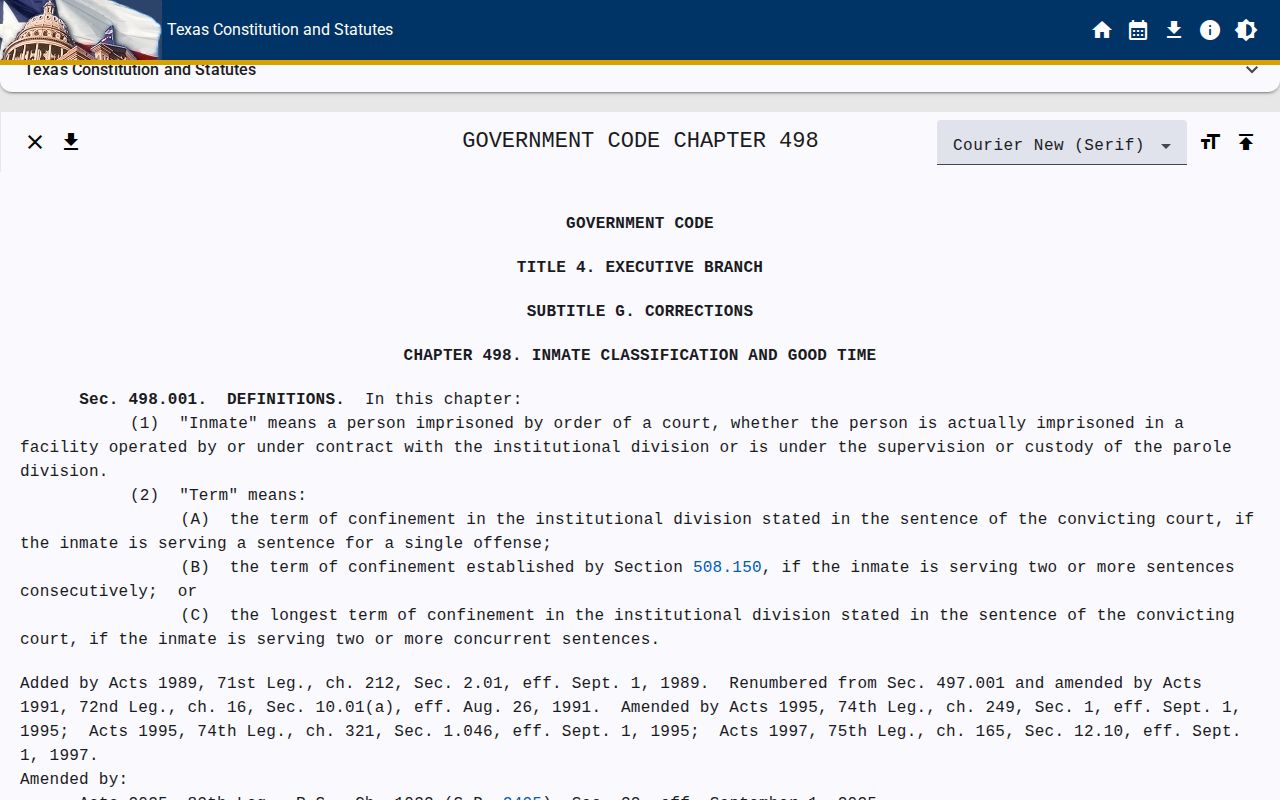
The statute supports an offense-specific review. It does not provide a simple date without the judgment, offense date, credit record, and TDCJ calculation.
Why Lamar County Release Dates Change
A date can move for several lawful reasons. The precise record should identify which one applies. Avoid guessing from a roster or from the passage of a projected date.
| Factor | Possible effect | Best record |
|---|---|---|
| Credit audit | Corrects sentence or time calculations | Jail or TDCJ computation |
| Good-time forfeiture or restoration | Changes eligible credit under governing rules | Agency credit record |
| Parole or mandatory-supervision decision | Allows, delays, or denies a conditional release path | BPP decision and TDCJ status |
| Program prerequisite | Delays scheduling until a required step is complete | TDCJ release-processing record |
| Detainer or warrant | May cause continued custody or transfer | Issuing and receiving agency records |
| Court correction | Changes sentence or credit terms | Signed court order |
| Concurrent or consecutive sentence | Changes how multiple terms run | Judgment and official calculation |
A date passing while the person remains listed does not let an outside observer declare an overstay. Ask for the calculation and court papers. If a hold belongs to another agency, determine whether the event will be community release or a transfer to that custodian.
Confirm Lamar County Actual Release
For Brown Avenue custody, the jail's dated release or transfer entry is the best proof of the physical endpoint. Pair it with the court order when the legal reason matters. A court date or bond order may authorize release, but it does not show when staff completed processing.
For TDCJ, follow the sequence from projected date to parole or mandatory-supervision decision, then scheduled date and location, then post-event status. TDCJ IVSS can provide an alert, but the agency record remains the stronger confirmation. The Lamar County VINELink release check explains the separate county and state notification portals.
Federal prisoners belong in the BOP locator. ICE custody belongs in ODLS and direct ERO channels. A Lamar County roster disappearance after a federal or immigration hold may be a transfer, not community release. Always name what the cited record proves.
Note: Record the search date and exact field label because projected, scheduled, transferred, released, and discharged describe different events.